Why Hiring a Web Agency Is Outdated in 2026
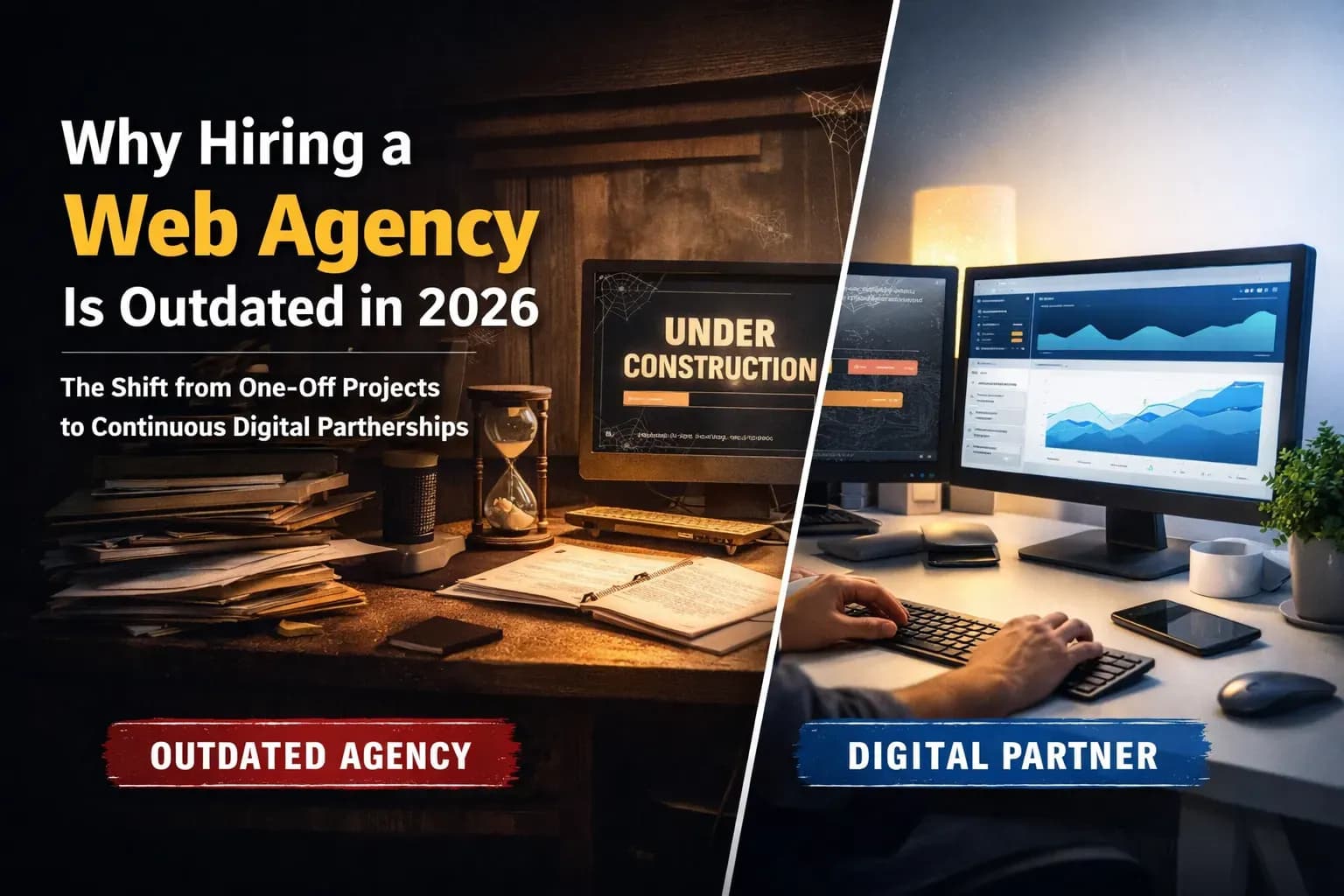
Why Hiring a Web Agency Is Outdated in 2026
Most businesses still hire web agencies for one-off projects.
In 2026, that model is no longer effective.
Forward-thinking companies are shifting toward digital partners focused on continuous improvement, performance, and long-term growth.
The Problem With the Project-Based Model
For years, businesses followed a simple approach:
- Hire a web agency → build a website → launch → move on
- This worked when digital moved slower
- Today, it no longer reflects reality
Most web agencies still operate with:
- Fixed scope
- Fixed timelines
- One-time delivery
Once the website is live, the project is considered complete.
But the reality is different:
Your website is never finished.
Markets evolve.
User behaviour shifts.
Competitors improve continuously.
Technology advances rapidly.
A static website in a dynamic environment becomes outdated quickly.
What Happens After Launch
This is where most businesses lose momentum.
After launch:
- Updates are delayed
- Performance is not actively measured
- Minor issues escalate over time
- Opportunities are missed
When performance drops, the response is predictable:
Another project. Another rebuild.
Build → wait → fix → rebuild
This is not growth.
It is reactive maintenance.
The Shift: From Agencies to Digital Partners
Leading businesses are moving away from one-off projects.
They are adopting ongoing digital partnerships.
Instead of asking:
“Can you build us a website?”
They are asking:
“Can you help us continuously improve our digital performance?”
This shift changes everything.
What a Digital Partner Delivers
A digital partner is not focused on delivery — but on performance.
They work with you consistently to:
- Improve website performance
- Optimise user experience
- Implement new features
- Align with business changes
- Support marketing initiatives
- Identify growth opportunities
Your website becomes a continuously evolving asset.
Why This Matters in 2026
Expectations have changed.
Users expect:
- Speed
- Clarity
- Seamless experiences
- Continuous improvement
If your website remains unchanged for 6–12 months, it is already underperforming.
Meanwhile, competitors are:
- Testing and refining
- Improving conversion rates
- Strengthening messaging
The gap widens — often unnoticed.
The Real Cost of One-Off Projects
Project-based work appears cost-effective upfront.
In reality, it leads to:
- Repeated redesign cycles
- Lost conversion opportunities
- Slow response to market changes
- Internal inefficiencies
The true cost is not the website.
It is the lost growth potential.
A Better Approach
Your website should be treated as an evolving business asset.
This requires:
- Continuous improvement
- Ongoing optimisation
- Strategic direction
- Long-term thinking
Not just delivery — but development over time.
Final Perspective
The question is no longer:
“Do we need a new website?”
The real question is:
“Do we have the right partner to improve it continuously?”
Because in 2026, growth does not come from launch.
It comes from ongoing optimisation and consistent improvement.
Your website should be improving every month.
If it is not, it is falling behind.
Most businesses are unaware of where they are losing performance, conversions, and growth.
Get a Digital Assessment to understand:
- What is underperforming
- Where opportunities are being lost
- What actions will drive improvement
This is not a generic audit. It is focused on measurable growth.
? Get Your Digital Assessment
Frequently Asked Questions
Is hiring a web agency still relevant in 2026?
Web agencies can still deliver projects, but the traditional one-off model is increasingly ineffective. Businesses focused on growth benefit more from ongoing partnerships.
What is the difference between a web agency and a digital partner?
A web agency delivers a defined project. A digital partner works continuously to improve performance, adapt to change, and support long-term strategy.
Why are one-off projects no longer effective?
Digital environments change rapidly. Without continuous updates and optimisation, websites lose relevance and performance over time.
How often should a website be updated?
Websites should be reviewed and improved regularly — ideally on a monthly basis — to maintain performance and competitiveness.
Is a digital partner more expensive?
While it involves ongoing investment, it is typically more cost-effective over time by avoiding repeated rebuilds and unlocking consistent growth.
Who should consider this approach?
Businesses that rely on their website for leads, sales, or brand positioning — particularly those aiming for sustained growth.