How to Build a Local SEO Strategy That Actually Works in 2026
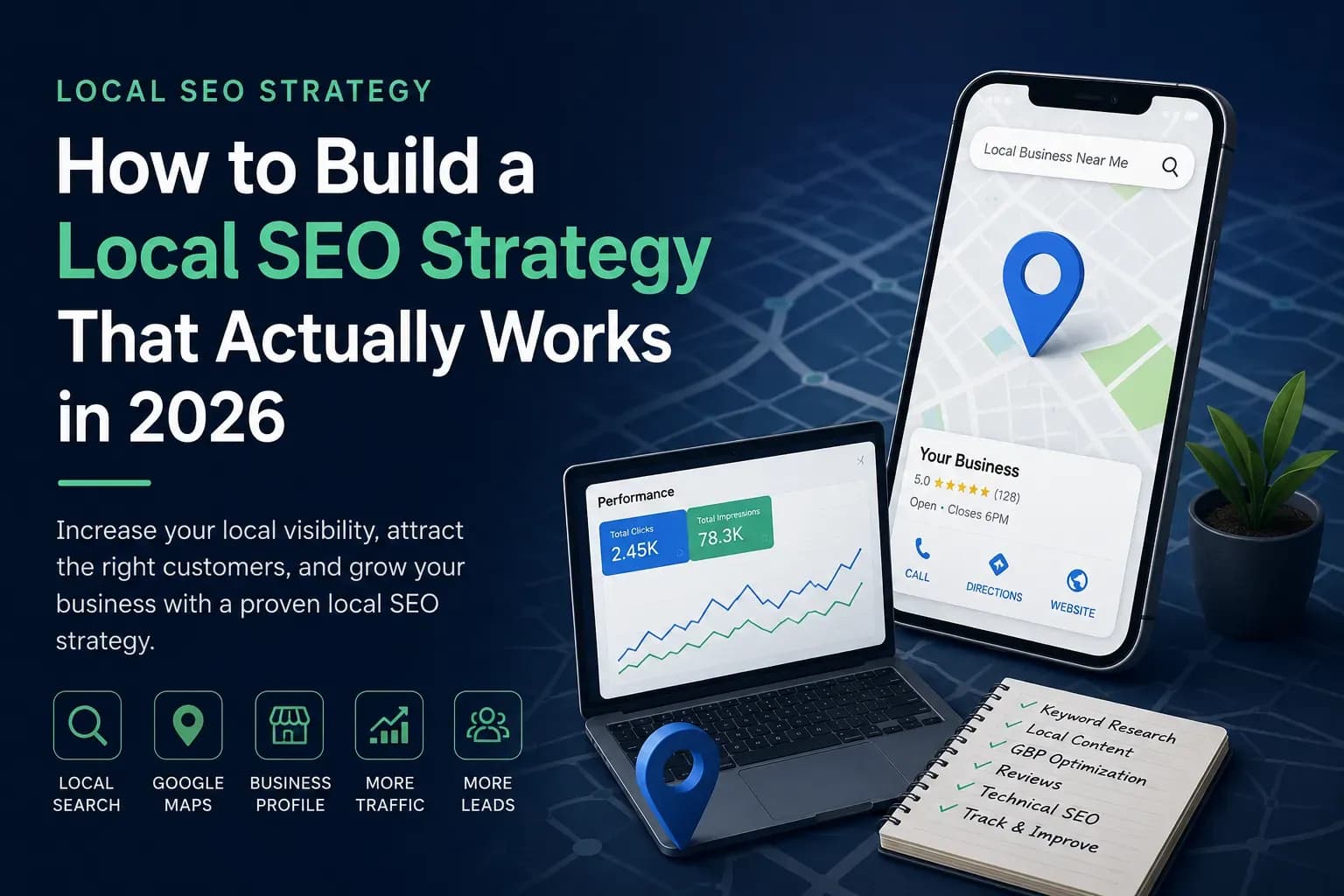
Getting a website online is no longer enough.
Businesses are competing for visibility across Google Search, Google Maps, local results and increasingly personalised search experiences.
The challenge is not simply having a website.
The challenge is making sure the right people can actually find it.
For local businesses, that requires a structured SEO strategy built around search intent, useful content, local relevance and strong technical foundations.
Local SEO Has Changed
Local SEO used to be relatively straightforward.
Create a website.
Add your location.
Set up a Google Business Profile.
Collect a few reviews.
Today, the competitive landscape is very different.
Businesses are competing across:
- Traditional Google search results
- Google Maps
- Local search results
- Google Business Profiles
- Informational searches
- AI-assisted search experiences
- Google's personalised content surfaces
Visibility is becoming broader than ranking for a handful of keywords.
Your business needs to demonstrate relevance, usefulness and authority across its entire digital presence.
Start With What People Are Actually Searching For
One of the biggest SEO mistakes businesses make is creating content based entirely on what they want to talk about.
A better strategy starts with actual search demand.
Google Search Console can show you the queries that are already generating impressions for your website.
For a digital business, these might include searches such as:
- SEO strategy 2026
- Web design
- SEO agency Meath
- Local SEO services
- Website optimisation
- Digital strategy
These impressions are valuable.
Google is already giving you clues about what it associates your website with.
Instead of ignoring those queries, turn the strongest opportunities into genuinely useful content.
For example:
"SEO agency Meath"
could support an article such as:
How to Build a Local SEO Strategy for a Meath Business
While:
"SEO strategy 2026"
could become:
SEO Strategy in 2026: What Businesses Need to Prioritise
The objective is not to repeatedly insert keywords into an article.
It is to understand the problem behind the search and provide the strongest possible answer.
Build an Industry-Focused Content Library
Your website should do more than explain your services.
Your homepage, service pages and contact pages are primarily designed to explain your offering and convert potential customers.
Informational content serves a different purpose.
It allows you to answer the questions potential customers are asking before they are ready to make an enquiry.
Build a growing library of useful content around topics such as:
- Local SEO strategies
- Website conversion optimisation
- Google Business Profile optimisation
- Website performance
- Digital strategy
- Search visibility
- Web design
- Lead generation
- Marketing automation
Each article creates another opportunity for potential customers to discover your business.
Over time, these articles also strengthen the expertise and authority behind your commercial services.
Think Beyond Traditional Google Rankings
Organic search remains important, but Google visibility is no longer limited to a standard list of search results.
Content can potentially appear across different Google search and discovery experiences.
That makes useful informational content increasingly valuable.
Commercial pages such as your homepage and service pages are designed primarily to convert visitors.
Informational articles serve a different purpose.
They can introduce your business to someone before that person is ready to request a quote, make an enquiry or book a call.
The journey can become:
Search → Useful Content → Trust → Service → Enquiry
That is why your blog should be viewed as part of your lead-generation strategy rather than simply somewhere to publish company updates.
Create Content Worth Discovering
Publishing more content does not automatically produce more organic traffic.
Quality matters significantly more than volume.
A strong article should:
- Answer a specific question
- Demonstrate genuine expertise
- Provide practical recommendations
- Use clear headings and structure
- Include useful original insight
- Link naturally to related resources
- Provide a logical next step
Avoid producing dozens of shallow articles simply to target keywords.
One genuinely useful guide can be more valuable than ten generic posts.
Your objective should always be to create something worth finding, reading and sharing.
Use Strong, High-Quality Images
Images are not only decorative.
They influence how your content appears when shared and can help your articles qualify for larger visual previews across Google's surfaces.
Every important article should have a strong featured image that clearly represents the topic.
For larger Google image previews, your website should allow large image previews.
Your blog template should be checked to ensure it is not unintentionally restricting them.
Where appropriate, your robots meta configuration should allow:
max-image-preview:large
Your featured images should also be:
- High quality
- Relevant to the article
- Properly compressed
- Accessible to search engines
- Accompanied by meaningful alt text
- Suitable for social sharing
Open Graph metadata should also be configured correctly so articles display professionally when shared across social platforms.
Optimise Your Google Business Profile
For businesses targeting customers within specific locations, your Google Business Profile remains an important part of local search visibility.
Make sure your profile contains accurate and complete information.
Review your:
- Primary business category
- Additional categories
- Services
- Website address
- Phone number
- Opening hours
- Business description
- Photos
- Customer reviews
Your website and Google Business Profile should reinforce each other.
Consistency builds stronger local signals and greater customer confidence.
Create Content Around the Locations You Actually Serve
If your business serves Meath, Dublin, Kildare or other locations, local relevance can form part of your content strategy.
But there is an important distinction.
Do not create dozens of almost identical pages where only the location name changes.
Instead, create genuinely useful location-specific resources.
For example:
How to Improve Local SEO for a Meath Business
could explore:
- Competition within the local market
- Google Maps visibility
- Local search behaviour
- Google Business Profile optimisation
- Customer reviews
- Local landing pages
- Website performance
This provides substantially more value than simply publishing another generic "SEO Meath" page.
Local relevance should add value, not just another keyword.
Connect Your Content
Individual articles should not exist in isolation.
Build relationships between them.
For example, an article about local SEO could naturally link to content about:
- Google Business Profile optimisation
- Website performance
- Conversion optimisation
- SEO strategy
- Web design
Those articles can then connect visitors to relevant service pages.
This creates a logical journey for both users and search engines.
Article → Related Insight → Service → Enquiry
Your content becomes part of the customer journey rather than a separate marketing activity.
Measure What Google Is Already Telling You
Google Search Console should be one of the main tools guiding your SEO content strategy.
Regularly review:
- Search queries
- Impressions
- Clicks
- Click-through rate
- Average position
- Pages receiving impressions
Pay particular attention to queries receiving impressions but relatively few clicks.
These can reveal valuable opportunities.
Google may already consider your website relevant to the search, but your current page, title or content may not yet be strong enough to capture the click.
Instead of guessing what to publish next, use real search data to prioritise your content.
Local SEO Requires Continuous Improvement
Publishing an article is not the end of the process.
SEO performance should be reviewed over time.
Existing content may need:
- Additional information
- Better internal links
- Improved titles
- Updated examples
- New imagery
- Stronger calls to action
- Better alignment with search intent
The same principle applies to your website as a whole.
Search behaviour changes.
Competitors improve.
Your business evolves.
SEO is not a project with a completion date.
It is an ongoing process of improving visibility, relevance and performance.
What to Do Next
If your website is already generating impressions in Google Search, the next step is to turn that visibility into more organic traffic and qualified enquiries.
Focus on three priorities:
1. Build Your Industry Content Library
Continue publishing useful, in-depth articles around the problems your potential customers are actively searching for.
Focus on topics such as:
- Local SEO
- SEO strategy
- Web design
- Website performance
- Conversion optimisation
- Digital strategy
- Google Business Profile optimisation
Each article should answer a specific question while naturally connecting readers to relevant services.
2. Target Search Queries Already Generating Impressions
Use Google Search Console to identify queries where your website is already appearing.
If you are receiving impressions for searches such as "SEO strategy 2026," "web design" or "SEO agency Meath," Google is already giving you useful information about potential content opportunities.
Turn those opportunities into comprehensive resources.
For example:
"SEO agency Meath" → How to Build a Local SEO Strategy for a Meath Business
"SEO strategy 2026" → SEO Strategy in 2026: What Businesses Need to Prioritise
The objective is not simply to target keywords.
It is to create the best possible resource for the person behind the search.
3. Enable Large Image Previews
Every article should include a high-quality featured image that supports the topic and works well across search and social platforms.
Check that your website allows Google to display large image previews and that your blog template does not restrict them.
Where appropriate, your robots meta configuration should allow:
max-image-preview:large
Combine this with high-quality featured images, descriptive alt text and correctly configured Open Graph metadata.
The goal is simple:
Search visibility → Useful content → Trust → Enquiry
Your blog should not exist separately from your lead-generation strategy.
It should actively support it.
Final Perspective
Successful local SEO in 2026 is not about finding one ranking trick.
It comes from combining:
- Useful content
- Search intent
- Local relevance
- Technical SEO
- Strong imagery
- Google Business Profile optimisation
- Internal linking
- Search performance data
- Continuous improvement
The businesses that win local search are the businesses that consistently provide useful answers when their customers are searching.
How visible is your business on Google?
Your website may already be receiving search impressions without converting that visibility into meaningful traffic and enquiries.
A Digital Assessment can help identify:
- Where your website is gaining visibility
- Where potential organic traffic is being lost
- Local SEO opportunities
- Website performance issues
- What should be prioritised next
Turn your existing digital presence into a clearer growth opportunity.
? Get Your Digital Assessment
Frequently Asked Questions
What is local SEO?
Local SEO is the process of improving a business's visibility for searches connected to a specific geographic area. It can include optimising your website, Google Business Profile, local content, reviews and other signals that help search engines understand where and who your business serves.
Why is local SEO important for businesses?
Local SEO helps businesses appear when potential customers are actively searching for relevant products or services within their area. This can generate highly relevant website traffic and enquiries from people with stronger purchase intent.
How long does local SEO take to work?
There is no universal timeframe. Results depend on competition, your existing website authority, technical condition, Google Business Profile, content quality and the strength of competitors. Local SEO should be treated as an ongoing strategy rather than a short-term campaign.
What is Google Search Console and why is it important?
Google Search Console provides information about how your website performs in Google Search. It can show the queries generating impressions and clicks, which pages appear in search results and where potential SEO opportunities exist.
Should businesses create content based on Google Search Console queries?
Yes, when those queries are relevant to the business and demonstrate genuine search demand. Search Console data can identify subjects Google already associates with your website and reveal opportunities for stronger, more comprehensive content.
Does a Google Business Profile help local SEO?
Yes. For businesses eligible for a Google Business Profile, an accurate and well-maintained profile can be an important part of local search visibility, particularly for Google Maps and location-based searches.
How often should SEO content be updated?
There is no fixed schedule that applies to every article. Important content should be reviewed periodically and updated when information becomes outdated, search intent changes, new opportunities emerge or performance indicates that improvements are needed.
Can local SEO generate leads?
Yes, but rankings alone do not guarantee leads. Effective local SEO needs to connect search visibility with relevant content, a strong website experience and clear conversion opportunities.
Is local SEO a one-time project?
No. Search results, competitors, customer behaviour and your own business change over time. Sustainable SEO requires ongoing measurement, optimisation and improvement.
Continue Improving Your Digital Performance
Local SEO is only one part of building a stronger digital presence.
Explore more insights and resources from ManartDigital:
Not Sure What Is Holding Your Website Back?
Your website may already be generating visibility without turning enough of that attention into enquiries.
A Digital Assessment can help identify:
- SEO and search visibility opportunities
- Website performance issues
- Conversion opportunities
- User experience improvements
- Areas that should be prioritised next
Take the next step and find out where your biggest digital growth opportunities are.