SEO Strategy in 2026: What Businesses Need to Prioritise
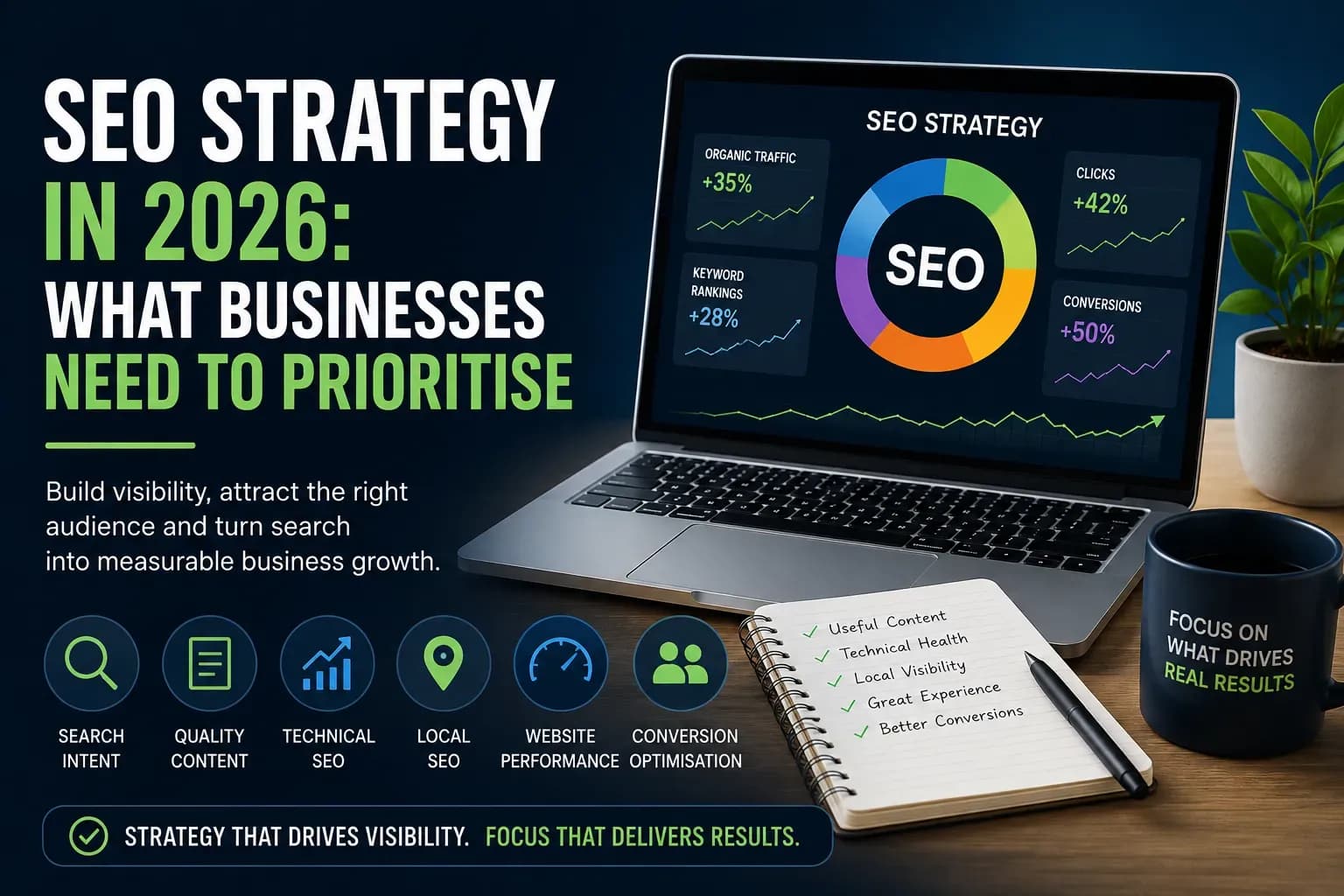
SEO has changed significantly.
Ranking on Google is still important, but a modern SEO strategy cannot be reduced to keywords, backlinks and publishing more content.
Search behaviour is evolving.
Competition is increasing.
AI is changing how people discover and evaluate information.
Google continues to develop how it understands websites, businesses and content.
For businesses, the objective is no longer simply to rank.
The objective is to build a digital presence that can be discovered, trusted and ultimately converted into business.
Here is what businesses should prioritise in their SEO strategy in 2026.
1. Start With Search Intent, Not Keywords
Keywords remain useful.
But a keyword alone does not explain what someone actually wants.
Consider someone searching:
"local SEO strategy"
They may want to:
- Understand local SEO
- Build a strategy themselves
- Compare SEO approaches
- Find an SEO provider
- Improve an existing campaign
The words matter.
The intention behind those words matters more.
Before creating a page or article, ask:
What problem is this person actually trying to solve?
Then build the content around that problem.
This creates a much stronger foundation than simply repeating a target keyword throughout a page.
2. Use Real Search Data to Guide Your Strategy
Businesses often decide what to publish based on assumptions.
There is a better source of information:
Your existing search data.
Google Search Console can show which queries are already generating:
- Impressions
- Clicks
- Search visibility
- Traffic to specific pages
This can reveal opportunities you may not have considered.
For example, if your website receives impressions for a relevant query but very few clicks, investigate why.
Perhaps:
- You do not have a dedicated article
- Your existing page does not fully answer the query
- Your title is not compelling
- The search intent does not match the page
- Competitors provide a stronger resource
Use data to decide what deserves attention next.
3. Build Topical Authority Instead of Random Blog Posts
Publishing disconnected articles makes it difficult to build a coherent SEO strategy.
A stronger approach is to develop content around areas directly connected to your expertise.
For example, a digital business could build a content cluster around:
Local SEO
Supported by articles covering:
- Local SEO strategy
- Google Business Profile optimisation
- Local keyword research
- Customer reviews
- Local landing pages
- Google Maps visibility
Another cluster could focus on:
Website Performance
Supported by content about:
- Website speed
- Conversion optimisation
- User experience
- Technical performance
- Website redesigns
- Continuous optimisation
The individual articles support each other.
Instead of publishing isolated posts, you build a connected library of expertise.
4. Connect Your Content With Internal Links
Internal linking is an important part of a structured website.
When you publish related articles, connect them naturally.
For example, if you want to understand local search in greater detail, read:
How to Build a Local SEO Strategy That Actually Works in 2026
And if Google Maps and local business visibility are important to your strategy:
How to Improve Your Google Business Profile in 2026
Internal links help visitors discover related information and help search engines understand relationships between your pages.
But links should be useful.
Do not add internal links simply because you can.
Connect pages where the next resource genuinely helps the reader.
5. Create Content That Demonstrates Real Expertise
The internet does not need more generic articles.
Businesses should focus on creating content informed by genuine experience.
That can include:
- Practical recommendations
- Original examples
- Lessons from real projects
- Industry observations
- Data
- Screenshots
- Case studies
- First-hand experience
If hundreds of websites already provide the same generic answer, simply rewriting that answer adds little value.
Ask:
What can we contribute that makes this resource genuinely useful?
That is a much stronger content strategy.
6. Prioritise Quality Over Publishing Volume
Publishing every day is not automatically better than publishing once a week.
A large collection of weak articles can create significant maintenance work without generating meaningful traffic.
Instead, prioritise content that deserves to exist.
Before publishing, ask:
- Does it answer a real question?
- Is it relevant to our business?
- Is it better than a superficial answer?
- Does it provide useful information?
- Does it have a clear purpose?
- Can it connect naturally to our other content?
Ten strong resources are more valuable than fifty articles written simply to maintain a publishing schedule.
7. Do Not Ignore Local SEO
For businesses serving defined geographic markets, local SEO should be integrated into the broader SEO strategy.
This can include:
- Google Business Profile optimisation
- Accurate business information
- Local content
- Customer reviews
- Relevant service areas
- Location-specific search intent
- Strong website pages
Your local SEO and broader organic strategy should reinforce each other.
For a detailed approach, see:
How to Build a Local SEO Strategy That Actually Works in 2026
8. Your Website Performance Matters
SEO does not stop when someone clicks a search result.
That click needs to go somewhere useful.
A website that is:
- Slow
- Confusing
- Difficult to use on mobile
- Outdated
- Hard to navigate
- Missing clear calls to action
can waste the visibility your SEO strategy worked to create.
Traffic without a strong website experience has limited value.
Your SEO and website strategy should therefore be connected.
Search creates the opportunity.
Your website needs to turn that opportunity into meaningful action.
9. Optimise for Mobile Users
Many customers will discover your business from a mobile device.
Your website needs to work properly on smaller screens.
Review:
- Navigation
- Font sizes
- Buttons
- Forms
- Page speed
- Images
- Calls to action
- Content layout
Do not assume that because a website technically loads on mobile, it provides a good mobile experience.
Test the actual customer journey.
Can someone find what they need quickly?
Can they contact you easily?
Can they complete your forms without frustration?
These details matter.
10. Technical SEO Still Matters
Strong content cannot compensate for every technical problem.
Search engines need to be able to access, understand and index your important pages.
Technical SEO considerations can include:
- Crawlability
- Indexation
- Canonical URLs
- Redirects
- XML sitemaps
- Page speed
- Mobile usability
- Structured data where appropriate
- Image optimisation
- Internal linking
- Duplicate content
You do not need to chase every technical metric simply because an SEO tool produces a warning.
Prioritise technical issues that materially affect users, crawling, indexing or performance.
11. Use Strong Images and Search Previews
Your content does not exist as text alone.
High-quality images can improve how articles appear when shared and across visual search and discovery experiences.
For important articles:
- Use a relevant featured image
- Optimise the file size
- Add descriptive alt text
- Use appropriate image dimensions
- Configure Open Graph information
- Allow large image previews where appropriate
Your page should also have a strong title and description.
Search visibility creates an opportunity.
The preview needs to earn the click.
12. Prepare for AI-Influenced Search
Search is becoming more conversational.
People increasingly expect direct answers rather than simply a list of websites.
That does not mean traditional SEO is disappearing.
It means businesses need to become better sources of information.
Content should be:
- Clear
- Well structured
- Accurate
- Specific
- Useful
- Easy to understand
- Supported by genuine expertise
Avoid writing content purely for algorithms.
Create information that deserves to be referenced because it genuinely answers the question.
13. Measure Business Outcomes, Not Just Rankings
Rankings are useful diagnostic metrics.
They are not the final business objective.
A business can rank for hundreds of irrelevant keywords and generate very little commercial value.
Instead, connect SEO performance to outcomes.
Monitor:
- Organic impressions
- Organic clicks
- Relevant traffic
- Enquiries
- Calls
- Form submissions
- Qualified leads
- Conversion rates
- Revenue where attribution is practical
Ask:
Is our organic visibility contributing to business growth?
That is a much more useful question than:
"How many keywords are we ranking for?"
14. Update Existing Content
SEO strategy should not focus entirely on producing new articles.
Existing content can become more valuable over time.
Review older pages and ask:
- Is the information still accurate?
- Has search intent changed?
- Can we add useful examples?
- Are there new internal links?
- Is the CTA still relevant?
- Is the featured image current?
- Is the title performing well?
- Are we receiving impressions but few clicks?
Sometimes improving an existing article is more valuable than publishing another one.
Content should be maintained as an asset.
15. Connect SEO With Conversion Optimisation
Generating more traffic is only part of the opportunity.
Imagine two businesses each receive 1,000 relevant organic visitors.
One converts 1%.
The other converts 3%.
The second business produces three times as many conversions from the same amount of traffic.
That is why SEO and conversion optimisation should not operate independently.
Once visitors arrive, review:
- Messaging
- Calls to action
- Trust signals
- Forms
- Navigation
- Page structure
- Mobile experience
- Landing pages
More traffic is valuable. Better use of existing traffic can be even more valuable.
SEO Should Be an Ongoing Process
One of the biggest mistakes businesses make is treating SEO as a project.
Optimise the website.
Publish some articles.
Build some links.
Finish.
But search does not stand still.
Competitors improve.
Customer behaviour changes.
Your services evolve.
Content becomes outdated.
New opportunities appear.
SEO needs continuous measurement and improvement.
The strategy should evolve with the business.
What Businesses Should Prioritise in 2026
If you are reviewing your SEO strategy this year, focus on the fundamentals before chasing trends.
Prioritise:
- Search intent
- High-quality content
- Topical authority
- Internal linking
- Local SEO where relevant
- Google Business Profile optimisation
- Website performance
- Mobile experience
- Technical SEO
- Conversion optimisation
- Measurement
- Continuous improvement
None of these works particularly well in isolation.
The strongest SEO strategies connect them.
Final Perspective
SEO in 2026 is not about tricking Google.
It is about building a digital presence that deserves visibility.
That means understanding what customers search for, creating genuinely useful information, maintaining a technically strong website and providing a clear path from discovery to conversion.
The businesses that succeed will not necessarily publish the most content.
They will build the most useful and coherent digital presence around the problems their customers are trying to solve.
Is Your SEO Creating Business Opportunities?
You may already be generating Google impressions and organic traffic without turning enough of that visibility into enquiries.
A Digital Assessment can help identify:
- Search visibility opportunities
- Content gaps
- Local SEO opportunities
- Website performance issues
- Conversion weaknesses
- Areas that should be prioritised next
SEO should do more than generate rankings. It should contribute to business growth.
Get Your Digital Assessment
Related Insights
Continue building your SEO strategy:
How to Build a Local SEO Strategy That Actually Works in 2026
How to Improve Your Google Business Profile in 2026
Frequently Asked Questions
What should an SEO strategy include in 2026?
A modern SEO strategy should combine search intent, useful content, technical SEO, internal linking, website performance, local SEO where relevant, conversion optimisation and ongoing measurement.
Is SEO still worth investing in during 2026?
SEO can remain valuable for businesses whose customers use search engines to research problems, compare providers or find products and services. Its value depends on targeting relevant demand and converting visibility into meaningful business outcomes.
How often should businesses publish SEO content?
There is no universal publishing frequency. Quality and relevance are more important than volume. A sustainable schedule of genuinely useful content is preferable to publishing frequently simply to increase article count.
How long does SEO take to work?
There is no fixed timeframe. Results depend on factors including competition, website authority, technical condition, content quality and existing search visibility. SEO should generally be approached as a long-term strategy.
What is topical authority?
Topical authority refers to building substantial expertise and coverage around a particular subject rather than publishing unrelated content across many topics. Connected, useful resources can help users and search engines better understand your areas of expertise.
Does local SEO need a separate strategy?
Local SEO has specific considerations, including Google Business Profile, reviews, local relevance and location-based searches. However, it should normally connect with your broader website and SEO strategy rather than operating independently.
Will AI replace SEO?
Search behaviour is changing as AI becomes more integrated into information discovery, but businesses still need accurate, accessible and useful digital content. The emphasis is increasingly on creating information that genuinely answers users' questions.
Are Google rankings the most important SEO metric?
No. Rankings can help measure visibility, but business outcomes matter more. Organic clicks, relevant traffic, enquiries, qualified leads and conversions provide a more complete picture of SEO performance.
Should businesses update old blog posts?
Yes, when there is a reason to do so. Existing articles should be reviewed when information becomes outdated, performance declines, new internal-link opportunities emerge or additional useful information becomes available.
What is the biggest SEO mistake businesses make?
One of the biggest mistakes is treating SEO as a one-time project rather than an ongoing process of measurement, content development, technical improvement and optimisation.